Evaluation is Never Neutral: Shifting Power at #EvalFest2026
In institutions and organisations, research and evaluation is often framed as technical and value-free. It isn’t. It is a reproduction of systems that have long reproduced extractive, colonial research practices where communities are treated as passive data sources rather than active change agents.
World YWCA’s RiseUp! Young Women’s Leadership and Advocacy Initiative in Asia and the Pacific is redressing this through its Formative Evaluation. Utilising World YWCA’s Feminist Consultation Methodology, young women co-researchers are at the centre of the evaluation – not as program participants, not as expert researchers, but a combination of both. Supported by our innovation partner, the Australian Government Department of Foreign Affairs and Trade, led by Elevating Voices for Change and The Mangrove Collective, we are turning traditional evaluation paradigms into different ways of thinking, doing, and knowing.
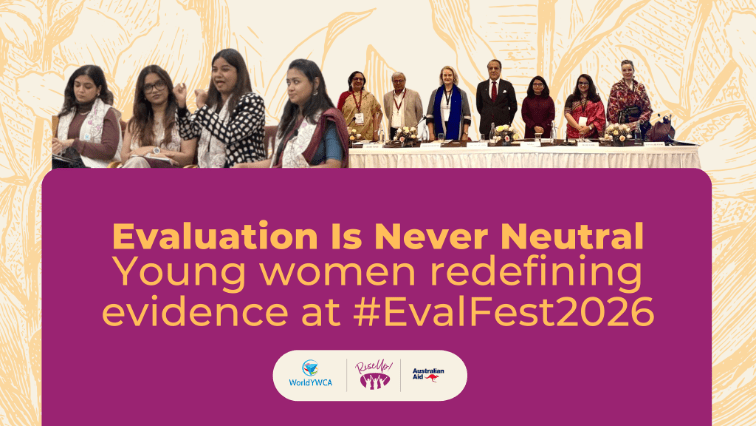
#EvalFest2026 in New Delhi for evaluation in Asia contexts – a biennial conference convened by the Evaluation Community of India and EvalYouth India to explore monitoring and evaluation in complex, evolving contexts provided an excellent opportunity to share the experiences of young women who have put World YWCA’s Feminist Consultation Methodology into action. This year’s theme, “Evaluation in complex and evolving contexts: Harmonising youth, innovation, and impact,” offered the perfect backdrop to centre young women’s authority over evidence. We questioned the idea of neutral data and named how the politics of research decide who holds power, whose stories are heard and who is relegated to the footnotes of their own stories.
For RiseUp!, evaluation is a truth‑telling practice – young women naming, in their own words, what it takes to shift power. As Dr Suchi Gaur, Senior Director of Strategy and Operations at World YWCA, put it: “Evaluation is the discipline that tells us in real time whether we are advancing justice or producing reports.”
The methodology: accountability as a radical act
To move from theory to practice, we need tools that keep power with young women. At EvalFest, young women shared their experiences of World YWCA’s Feminist Consultation Methodology (FCM). The Feminist Consultation Methodology (FCM) is not just a research method. It is a way to democratise how evidence is built. Standard models focus on accountability to donors. FCM shifts accountability to the communities, especially young women, whose work makes change possible. And it includes consent, safety, and data governance – who stores it, who can share it and who decides what is published.
When we get this right, the impact is profound.
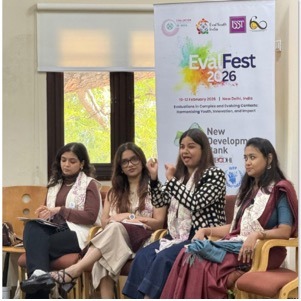
The discussion among four young women who have used FCM for very different purposes all said the same thing – this methodology allows us to decolonise the way we have been taught to think about knowledge and power. Vrushali Kadam, Aarushi Khanna, Charu Narang, and Dr Alpaxee Kahyap explored the inherent tensions in community-led accountability.
Vrushali Kadam, queer gender justice researcher, youth advocate, co-creator of Feminist Manch, and Board Member of Chalk Back, reflected on her use of FCM across two projects — Politics4Her Asia’s research on SRHR among queer and marginalised young women, and Feminist Manch’s collective documentation of lived realities of care, safety and access — where women were positioned not as passive respondents but as data sources, analysts and owners.
As one co-researcher said to Vrushali: “This was the first time I was asked to tell my story without being interrupted, judged, or spoken over. That’s what dignity felt like.”
For Vrushali, “the divide between anecdote and legitimacy collapsed once we recognised testimony as empirical description of social systems.” Through Feminist Manch, FCM also structured how the collective built trust and shared authority internally — studying their own participation architecture alongside broader systems. Vrushali left us with three remaining tensions: FCM is slow by design but funding rewards speed; shared politics does not equal equal voice; and donor systems want clean indicators that flatten the layered truth FCM produces — an evidence problem that requires institutions to expand what counts as legitimate data. As bell hooks reminds us, life-transforming ideas come through the voices of women and queers. FCM creates the conditions for those voices to lead. Vrushali left us with a powerful truth – “dignity is a measurable outcome”.
Aarushi Khanna, a young feminist leader, is the Asia Pacific Regional Lead for Equal Measures 2030 and a youth co-creator with Feminist Manch. Drawing on her work with Equal Measures 2030 and Feminist Manch, Aarushi described how FCM enables young women to talk back to the data. For many, this has been the first time they have seen themselves not as survey respondents but as researchers, analysts and strategists.
“FCM did not just surface insights,” Aarushi noted. “It rewrote who owns evidence, who defines priorities and who imagines change.”
To protect what she calls the “dignity of not being interrupted”, Aarushi reminds researchers and practitioners that they must sit with four critical questions:
- Who owns this process?
- Who benefits from this evidence?
- Who gets to define the problem?
- Who is missing?
Charu Narang is an activist in the Deaf community, the co-founder of Deaf Women Too and the Associate Manager at Hear A Million (EnAble India). As co-researcher in the RiseUp! Formative Evaluation Charu She spoke about the ongoing access challenges, including the limited availability of ISL interpreters and how Deaf participants sometimes are creatively using tools like ChatGPT to help translate from English and ISL. She also highlighted the diverse stories of Deaf women, showing how their journeys are shaped by multiple identities and experiences. Charu discussed the digital divide, where fewer laptops and limited access to technology—especially in rural areas—create challenges for Deaf women.
Despite this, many women work hard and continue to succeed. She also highlighted how important it is to raise awareness about Sexual and Reproductive Health and Rights (SRHR). By creating safe and trusting spaces through Deaf Women Too, using the Feminist Consultation Methodology (FCM), Deaf women can share and learn in ways that work for them. FCM does more than invite Deaf women to take part. It recognises them as experts who help shape the questions, set the pace, and decide how their stories are recorded.
Charu shared powerful stories of Deaf women who showed courage and resilience. Some challenged dowry practices, some faced resistance from family and community, and others navigated difficult experiences like divorce while standing up for their rights. These stories show that when Deaf women’s agency and expertise are respected, the process leads to richer data and a stronger sense of dignity, solidarity and collective power.
Dr Alpaxee Kashyap is an independent consultant and a founding core member of the Gender Equity Network South Asia(GENSA) and an Evaluation Associate with Elevating Voices for Change. Dr Alpaxe shared that as an Evaluation Navigator for the RiseUp! formative evaluation, accountability was multidimensional and shared — traditional hierarchical roles were intentionally blurred, with co-researchers central to co-designing, implementing and analysing the evaluation. As young women themselves, some also RiseUp! participants, they created the safe environment that the Feminist Consultation Methodology advocates.
Stories invited participants to share what felt most meaningful, with outcomes traced from narratives during analysis rather than imposed through technical language during storytelling. Small moments during the exercise also reflected how power was shared within the process. For instance, when a sticker fell off the chart, participants collectively found creative ways to make it stick again, laughing together as they did so. No single person held authority over where or how the ratings were placed on the matrix. Instead, participants collectively decided how to position their responses. Co-researchers supported the process by explaining each outcome indicator in simple and accessible ways, helping participants think through their responses. Participants were also encouraged to discuss their choices with each other and change their ratings if they wished after these conversations.
Unlike conventional evaluations, FCM ensured power was genuinely shared — accountability emerged as relational, multidimensional and held collectively.
The big picture: Youth authority as the antidote to extraction
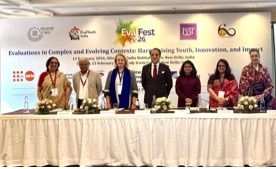
In the opening plenary, Dr Suchi Gaur called for the sector to move beyond passive, technical language. The plenary focused on the theme with speakers from UNFPA India and Bhutan Country Office; UN World Food Program, Empower and New Development Bank.
She connected the themes of Youth, Innovation, and Impact into a harmonious bridge by explicitly citing examples from the World YWCA’s work with youth, and by using evaluation and funding frameworks to showcase that walking the talk is not just possible; it must be what we, as practitioners and facilitators, commit to.
RiseUp! is built on a shift: not seeing young people as marginalised, but naming them as systemically excluded. Calling someone ‘marginalised’ frames exclusion as accidental. Naming it as ‘excluded’ makes clear it is a systemic choice that benefits those in power.
Calling for innovation to be seen beyond technology and more aligned with ensuring community and people impacted, including youth, are leading it, is instrumental.
Real innovation in our sector is measured by how much it reduces extraction and restores decision-making power to young women. The key question is simple: Does this process leave the community, especially young women, with more power than before?
Across Asia and the Pacific, RiseUp! young women leaders are combining youth authority, innovation and impact so that those most affected by conflict and injustice can define progress for themselves. By youth authority, we mean young people having real decision-making power over questions, methods, interpretation and how findings are used – not just being consulted. She challenged the audience, especially those designing evaluation work, towards three key asks to be made normal around making evaluation, match complexity:
– Fund evaluation as a learning function across the life of the programme, of innovations, not just at the end.
– Require participatory interpretation and community feedback as quality standards.
– Reward truth-telling: uncertainty, adaptation, and course-correction—not just “success”.
The system shift: Who decides what counts as expertise?
In the plenary discussion Inclusion of Youth and Gender in Evaluation, Victoria Kahla, Programme Manager for RiseUp! in Asia and the Pacific, challenged this pattern: “In a sector grappling with how to decolonise… who decides what rigour means? Who holds expertise? If we do not centre young women in the ecosystem, we are in fact being the opposite of robust.”
RiseUp! Asia Pacific’s monitoring, evaluation, and learning framework was developed by young women. Young women themselves knew that only counting how many people attended an activity, and what percentage say they are more confident after, is not a measure of transformation. They developed a series of progress markers and a very sophisticated matrix for applying these markers to assess progress for individual young women, their peers, families, communities. They didn’t develop this because they are technical experts in evaluation, but because they know that the changes we are trying to measure are complex. They know that not all young women start from the same place, that context is paramount, and transformation does not happen in a straight line.
When rigid frameworks are put above real conditions, we are not being objective. We are silencing those we claim to serve and reinforcing institutional control. World YWCA shifts ownership of evidence by recognising that the most rigorous data comes from those living the reality: young women themselves. We are moving from one-size-fits-all metrics to context-driven processes, where ownership is essential.
The Power Shift
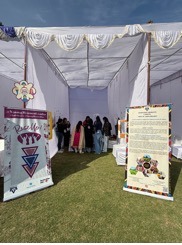
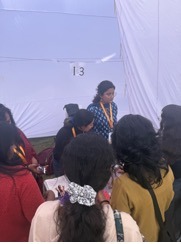
At the EvalFest Innovation Bazaar, young women demonstrated the ‘evidence ecosystem’ in real time: explaining methods, sharing learning and asserting ownership of findings.
Led by YWCA of India, Dhiya Ann Mathew, National General Secretary, Pranita Biswasi, National Advocacy and Programme Manager, and Amanda Fernandes, RiseUp! Young Woman Lead were joined by three young women RiseUp! formative evaluation co-researchers – Sachu R Sunny, Sheetal Kumari, Christymol MA, and Arpita Raj. At the bazar, young people witnessed the work of YWCA of India through RiseUp! By engaging in innovative conversations, games with the team. The booth was full with young people and experts flowing in to know about the work of YWCA of India within the RiseUp! Initiative.
As Sachu reflected on her role as co-researcher, “This experience has reshaped how I listen, interpret, and write about lived experiences in my own academic work. I realize hearing lives through numbers is possible when the quantitative and qualitative approaches are allowed to work together rather than in opposition.”
Beyond the spreadsheet: Towards community‑owned evidence
The RiseUp! Asia Pacific Formative Evaluation is clear: data and evidence are political tools for justice, not just metrics for an end-of-project report.
As #EvalFest2026 closed, young women and their allies called on the global community to treat research as part of building resilient ecosystems that can withstand political, economic and environmental crises. This means resourcing young women to design questions, lead consultations, own findings and bring their evidence into decision-making spaces.
We refuse to accept participation as a substitute for ownership. We choose to legitimise community-led evidence so young women can stand as equals in global governance and peace processes, not as an afterthought or a photo in the annex.
As Victoria Kahla reminds us: “Numbers tell us the extent of change. Stories tell us the quality of the change.” We refuse to turn stories into numbers that fit neatly into a spreadsheet. We choose dignity over extraction.
To our community of activists, evaluators and partners: What do you actively measure in your work? And what is the one thing you absolutely refuse to flatten into a spreadsheet to try and prove your impact?
About the RiseUp! Asia Pacific Formative Evaluation RiseUp! Young Women’s Leadership and Advocacy Initiative in Asia and the Pacific is a flagship initiative of World YWCA, in partnership with the Australian Government Department of Foreign Affairs and Trade. RiseUp! in Asia and the Pacific is led by partners and young women in Bangladesh, India, Myanmar, Nepal, Papua New Guinea, Solomon Islands, Sri Lanka, and Thailand, contributing to World YWCA’s Goal 2035: 100 million young women and girls will transform power structures to create justice, gender equality and a world without violence and war. World YWCA commissioned Elevating Voices for Change and The Mangrove Collective to lead the RiseUp! Asia Pacific Formative Evaluation, co-designed with an intergenerational Steering Committee of RiseUp! Asia Pacific leaders. It is a collaboration grounded in World YWCA’s Feminist Consultation Methodology, ensuring that data collection and sense-making are owned by young women who have participated in RiseUp! These RiseUp! young women co-researchers were coached and supported by Evaluation Navigators in six countries – Bangladesh, India, Myanmar, Nepal, Solomon Islands and Thailand. RiseUp! partners YWCA of Bangladesh, YWCA of India, YWCA of Myanmar, YWCA of Nepal, Hauskuk Initiative PNG, YWCA of Sri Lanka, and YWCA of Thailand have worked with Evaluation Navigators and RiseUp! young women co-researchers to support data collection and sense-making in their RiseUp! communities. This deeply collaborative evaluation is the result of an unwavering commitment to the values and practices of community-led accountability.