The World YWCA seeks proposals from interested individuals or groups to conduct research focused on understanding and unpacking the gendered dimensions of language including but not limited to, where language holds masculine and feminine articles; where language is an ongoing tool of colonization, particularly English and European languages; conveying meaning and transformative feminist values through translation and interpretation where there are no equivalent words; conveying meaning and feminist values through translation and interpretation where concepts and words hold negative or culturally controversial connotations, other meanings, or double meanings; codeswitching in hierarchical and patriarchal contexts, particularly amongst young women.
Through its flagship program RiseUp! Young Women’s Leadership and Advocacy Initiative in Asia and the Pacific, the World YWCA is seeking consultant/s to explore the nexus of language, power, and feminist values using the World YWCA’s Feminist Consultation Methodology (FCM). The consultant/s will explore language and power by coaching and facilitating young women and women to conduct their own research in their local communities using FCM.
Before applying, this methodology should be read carefully and the proposal must be clear about the roles consultants will play and the approaches they will take.
Location: Remote
Closing date for Expression of Interest: 19 September, 2025
Starting date: September 2025
Type of agreement: Consultancy – estimated working days maximum 60 days over 6-8 months
Across the globe, 604 youth-led projects reaching an estimated 427,500 people in underserved communities will be awarded €1.2 million through the Youth Empowerment Fund (YEF) via its Youth-led solutions through the Big Six Network’s call. A partnership of the European Union (EU) and Big Six Youth Organizations (Big Six), implemented by the Global Youth Mobilization (GYM) – the YEF supports young people in more than 64 countries and national organizations within the Big Six networks. Through the YEF, young people are mobilized to implement youth-led grassroots projects which address the world’s biggest challenges and accelerate the advancement of the Sustainable Development Goals (SDGs).
From addressing climate change and gender equality to access to education and employment, the YEF is a powerful initiative that empowers young individuals and groups to imagine, lead, and implement grassroots solutions. The YEF breaks barriers for young people in accessing funding, capacity building, and advocacy spaces and supports the vision, creativity, and leadership of young changemakers working to create lasting impact worldwide.
Funding through the Network Solutions call was provided from the local to district, national and regional levels, empowering young innovators within the Big Six networks to create real positive change in their local communities, especially those from vulnerable, socio-economically disadvantaged, or marginalised backgrounds, including youth with disabilities and those facing gender-related challenges. Funds of €500 – €5000 were granted to local level initiatives, while funds within the range of €10,000- €30,000 were granted to the national and regional level initiatives.
Through both online and offline support, young people are not only granted access to funding but are also equipped with the tools, mentorship, and capacity building needed to turn their ideas into lasting, community-driven impact and with opportunities to amplify their voices on different platforms via their respective Big Six organizations.
Here is a snapshot of how each Big Six organization empowers young people through the Youth Empowerment Fund Network Solutions:
The IFRC continues to empower youth innovation at the grassroots level through its flagship initiative – the IFRC Limitless Youth Innovation Academy which runs in four phases. Having supported 1500 projects in Phase 1 (The Innovation Journey), 905 in Phase 2 (Implementing Prototypes and Pilots), and 105 during Phase 3 (Advanced Development), the IFRC Limitless Academy has just awarded 10 top initiatives to receive final funding in Phase 4 (Growing the Ideas). Final awardees will have four months to fully implement their innovation, supported by expert mentors, peer learning communities and training.
Here is a snapshot of a few YEF Network Solutions projects under the IFRC:
Mathew Cedeño – Ecuadorian Red Cross
Level of Funding: Local
Location: Ecuador
Main SDG Addressed: SDG 2 – Zero Hunger
Number of Beneficiaries: 836 people
Project Overview:
This project by the Ecuadorian Red Cross transforms agricultural and organic waste into valuable resources, boosting sustainability and livelihoods in rural communities. A key achievement was developing a method to process banana plant pseudostems into a nutritious, marketable ingredient, now used by 150 families—reducing waste and creating new income sources.
The project also tackled the environmental impact of burning bean waste by converting it into useful products, promoting sustainable farming, and reducing harmful emissions.
Additionally, the project developed a method to process crickets as a low-cost, high-protein food for people to eat and an affordable chicken feed option for farmers. This solution supports food security and sustainable farming. Overall, the project demonstrates how innovative, locally adaptable methods can improve environmental sustainability, economic resilience, and food systems for rural communities.
Nandom Mampak Gideon and Mercy Atsuko – Nigerian Red Cross
Level of Funding: Local
Location: Nigeria
Main SDG Addressed: SDG 7 – Affordable and Clean Energy
Number of Beneficiaries: 371 people
Project Overview:
Young volunteers from the Nigerian Red Cross piloted a bio-gas system in a rural community, showcasing how clean energy can drive social and environmental change. By replacing firewood with renewable bio-gas, the project significantly reduced indoor air pollution, improving respiratory health—especially for women and children—and lowering medical costs. Beyond health, the initiative empowered women and spurred social transformation by eliminating the need for firewood collection—freeing time for education, income-generating activities, and community leadership.
The system also produces biofertilizer as a byproduct, which can be used in gardens and farms to improve soil fertility and crop yields. This organic alternative reduces reliance on harmful chemical fertilizers, and families can now grow more nutritious food, enhancing diets and contributing to better health outcomes.
Through an integrated approach to a single, sustainable solution, this project led by the young volunteers at the Nigerian Red Cross addresses multiple challenges—energy poverty, environmental degradation, and poor health—and empowers the community to build resilience and shape its own future.
WAGGGS is advancing youth-led impact through two robust funding cycles, reaching 21 Member Organizations, with 3 more on the cusp of joining. Their approach emphasizes continuous learning and connection. Awardees share insights through peer learning spaces, mentoring clinics, and WhatsApp support groups, while tracking progress via detailed reporting tools. Upcoming months will focus on mentorship and thematic engagement, helping young leaders translate their bold ideas into meaningful, measurable action that uplifts girls and young women across communities.
Here are some examples of Network Solutions projects under WAGGGS:
Empowering Youth for Climate Action
Level of Funding: National
Location: Uganda
Main SDG Addressed: SDG 13 – Climate Action
Number of Beneficiaries: 6000 people
Project Overview: In southwestern Uganda’s Nakivale Refugee Settlement—one of Africa’s oldest and largest—refugees face urgent environmental and socio-economic challenges, including deforestation, land degradation, and limited access to sustainable resources. In response, the Uganda Girl Guides Association (UGGA) launched a youth-led climate initiative empowering residents aged 14 to 30 with practical skills and knowledge to become environmental leaders.
Through hands-on training and workshops, youth are learning to implement local climate solutions such as reforestation, rainwater harvesting, renewable energy use, and sustainable farming techniques to enhance food security and restore the environment.
To ensure long-term impact, UGGA collaborates with local organizations, community leaders, and government agencies like the National Environment Management Authority (NEMA). These partnerships are embedding environmental stewardship into community values and decision-making processes.
This initiative not only addresses environmental degradation but also promotes youth empowerment, social inclusion, and community resilience. By equipping young people with the tools to lead, UGGA is helping transform Nakivale into a model of grassroots climate action—proving that even in challenging contexts, youth-led solutions can drive lasting change.
AFIMA
Level of Funding: National
Location: Côte d’Ivoire
Main SDG Addressed: SDG 4 – Quality Education
Number of Beneficiaries: 2800 people
Project Overview: In Côte d’Ivoire, children with disabilities face major educational barriers, including limited access to Braille materials, audiobooks, and inclusive teaching methods. To address this, the Association des Guides Catholiques de Côte d’Ivoire launched an inclusive library in Abidjan that welcomes both disabled and able-bodied children.
The inclusive space offers a wide range of educational resources—traditional books, Braille, audiobooks, and digital tools like screen readers and sound amplifiers. Where possible, the library is mobile—extending its reach to children across different communities.
Rooted in equity and inclusion, the project fosters a shared learning space that breaks down stigma, boosts confidence among children with disabilities, and raises community awareness. Young members of the Association are leading the way—undergoing training in diversity, library organisation, event planning, and advocacy as they gather and curate educational materials for the library. Their leadership and commitment are key to ensuring that the space is not only resource-rich but also welcoming and empowering.
The initiative supports several Sustainable Development Goals, including quality education (SDG 4), reduced inequalities (SDG 10), good health and well-being (SDG 3), sustainable communities (SDG 11), and partnerships (SDG 17). Through this project, the Association is empowering all children—regardless of ability—with the tools, confidence, and support to thrive.
The Award has launched its YEF Network Solutions call for applications and successfully disbursed Round 1 funding to two promising national-level projects. Selection of Round 2 applications has been completed and different implementation modalities are being explored. Projects accepted by The Award involve Youth from end-to-end. From design and application, through to the review by The Award, implementation and being the focus stakeholder. The Award provides personalised support sessions, project planning capacity-building, and regular check-ins for its awardees. Round 3 funding is in the first stages of preparation.
These are some of The Award’s selected projects under YEF Network Solutions:
Tishange- Let’s Plant Trees!
Level of Funding: Local
Location: Lusaka, Zambia
Main SDG Addressed: SDG 13 – Climate Action
Number of Beneficiaries: 300 young people + 820 people of all ages
Project Overview: “Tishange” is a youth-led tree planting and climate change sensitization initiative in Zambia, focused on tackling drought and desertification through reforestation and environmental education. The project involves students from three secondary schools—Kabulonga Boys School for the Differently Abled, David Kaunda STEM Secondary School, and Holy Cross Secondary School—who will lead the design and implementation of the initiative.
Key activities include planting trees (with a focus on fruit-bearing species), selecting suitable sites, and ensuring long-term tree maintenance. The initiative also features educational workshops and community outreach to raise awareness about climate change and promote sustainable land practices. Additionally, students receive leadership, environmental management, and advocacy training, supported by climate change experts’ mentorship, helping them build critical skills for future climate action.
Ensuring Inclusive & Quality Education for young people with Disabilities
Level of Funding: Local
Location: Accra, Ghana
Main SDG Addressed: SDG 4 – Quality Education
Number of Beneficiaries: 100 young people living with disabilities
Project Overview: This 12-month project, set to run in Accra from January to December 2025, aims to improve access to inclusive, quality education and employment opportunities for young people with disabilities (PWDs), with a focus on girls. Recognizing the systemic barriers PWDs face, the initiative emphasizes non-formal education, skills development, and mentorship to build resilience and support sustainable livelihoods.
Key components include delivering an Award Framework for 100 youth with disabilities, incorporating voluntary service, skills training, physical recreation, and adventurous journeys. The project also focuses on policy advocacy, collaborating with policymakers and advocacy groups to promote inclusive education policies and secure funding.
Additionally, the initiative provides capacity building and skills training for youth, educators, and administrators, alongside the creation of mentorship programs. Through the project, resource improvement such as accessibility audits and provision of adaptive technologies will enhance learning environments for PWDs, while inclusive community events will help combat stigma and promote social integration. By combining education, empowerment, and advocacy, this initiative seeks to create lasting change and foster a more inclusive society where young people with disabilities can thrive.
World Scouting is spearheading 20 youth-led initiatives through its global network of National Scout Organizations (NSOs), with funding fully allocated across themes like climate action, mental health, life skills, and gender equality. Scouting’s commitment to action is as strong as ever—empowering youth with the skills and resources they need to shape resilient and thriving communities.
Below are a few YEF Network Solutions projects under World Scouting:
Resilient Communities: Fiji Scouts for Inclusion, Climate Action and Disaster Preparedness
Level of Funding: National
Location: Fiji
Main SDG Addressed: SDG 13 – Climate Action
Number of Beneficiaries: 5,450 people
Project Overview:
This youth-led project will empower over 2,000 young people across Fiji—including more than 500 persons with disabilities—to lead climate action and strengthen disaster resilience. Through district-level training, school outreach, rural engagement, and inclusive community-based preparedness strategies, the project aims to build a more informed and climate-ready generation.
Implementation will focus on Fiji’s Western and Eastern Divisions, in close partnership with the National Disaster Management Office. The initiative will also include school-based interventions to foster environmental awareness and resilience among students, ensuring youth are central to climate response efforts.
Building on previous climate change awareness activities delivered through Messengers of Peace community projects, this initiative continues to promote youth leadership in environmental action. Rooted in World Scouting’s global vision, the program emphasizes peacebuilding, inclusion, and community engagement—empowering young people to create positive, sustainable change at both local and national levels.
Supporting South and Central Albanian Youth through Scouting
Level of Funding: National
Location: Albania
Main SDG Addressed: SDG 11 – Sustainable Cities and Communities
Number of Beneficiaries: 1,170 people
Project Overview:
This youth-led initiative aims to empower rural youth to become agents of change by leading community-based initiatives that address local Sustainable Development Goal (SDG) challenges. Through a combination of training, mentorship, and inclusive youth leadership development, participants will implement impactful actions focused on climate resilience, environmental protection, and gender equality—fostering civic engagement and strengthening rural communities.
The project strongly emphasizes engaging rural youth, particularly in designing and executing projects that integrate gender equality with climate action. Building on the successful legacy of youth-led environmental and gender-focused initiatives in northern Albania, this initiative brings that momentum to the south and central regions.
A key project component is a participatory workshop involving 40 youth, providing hands-on training in community development, youth engagement, and inclusive leadership. Rooted in the values and methodology of Scouting, the project aligns with broader youth empowerment and growth strategies, equipping participants with the tools to lead sustainable, community-driven transformation across Albania.
The World YMCA is nurturing a new wave of youth-led initiatives, having funded six national-level projects and one regional-level project from its first call. A second round of funding is now underway and targets at least 13 new awards in 2025. Through the YEF Network Solutions, the YMCA is providing essential capacity building and resources for youth-led initiatives that are responding to the needs of focus communities, while also advancing the achievement of the SDGs. Through quarterly check-ins, and tailored guidance for implementation and reporting, awardees are already forging ahead with impactful work. Capacity building activities and leadership development are central to the YMCA’s model, ensuring that each project— will lead lasting transformation.
These are a few of the YEF Network Solutions projects under World YMCA:
YMCA Cameroon Recycling Unit
Level of Funding: District
Location: Yaoundé, Cameroon
Main SDG Addressed: SDG 13 – Climate Action
Number of Beneficiaries: 1,200 young people
Project Overview:
The project aims to reduce plastic pollution in the city of Yaoundé and change people’s behaviors on waste management in the city. The project will establish a small recycling unit to serve the community surrounding the National Office. In addition, the YMCA will conduct waste management training in at least 20 schools in the city and support them to develop a waste management system and increase their knowledge on SDGs.
YMCA LAC Youth Mental Health Program, Eleva
Level of Funding: Regional
Location: Honduras, Mexico, Peru
Main SDG Addressed: SDG 3 – Good Health and Wellbeing
Number of Beneficiaries: 1,510 young people
Project Overview: Eleva is a transformative initiative in Latin America and the Caribbean, focusing on youth mental health and well-being. It employs a community-based and participatory approach to prevent mental health disorders and combat stigma. The project empowers youth aged 14-30 from vulnerable populations, including survivors of domestic violence, indigenous and migrant communities, and the LGBTQ+ community. Through youth-led activities, Eleva aims to enhance mental health awareness, develop skills, and promote inclusivity, with a strong emphasis on gender justice and digital literacy.
The World YWCA is amplifying youth voices and deepening impact by fostering bold, grassroots-driven transformative leadership among girls, young women, and women worldwide. From its first round of funding, the World YWCA has mobilized all seven awardees at the national level and is currently preparing for a second round of funding. Through intergenerational leadership, strategic communication, and resource sharing, the World YWCA is championing young women’s active engagement in leadership, advocacy, and innovation contributing to the Sustainable Development Goals aligned to the Goal 2035 of World YWCA.
Here are some YEF Network Solutions projects selected by World YWCA:
EmpowerHer: Young Women Leading Climate Action for a Sustainable Future
Level of Funding: National
Location: Albania
Main SDG Addressed: SDG 13 – Climate Action
Number of Beneficiaries: 90 young women
Project Overview:
The project aims to empower 90 young women in Albania by providing them with the RiseUp! Leadership Guide, project management, and environmental advocacy skills. These women will lead 6 Local Solutions projects focusing on environmental sustainability and also raise awareness within their communities about climate change and gender equality.
YWCA Young Women as Gender Responsive Climate Advocates: YWCA of India Flagship Programme
Level of Funding: National
Location: India
Main SDG Addressed: SDG 13 – Climate Action
Number of Beneficiaries: 350 young women
Project Overview:
This project aims to empower 350 young women with leadership training and advocacy tools focused on climate action and gender justice. Through a combination of in-person and virtual workshops, these young women will develop the skills to lead climate action Local Solutions in their communities. It targets young women from marginalized, rural, slum, tribal, and semi-urban communities, as well as underrepresented groups.
BACKGROUND
The Youth Empowerment Fund (YEF) is a partnership between the European Union (EU) and the Big Six Youth Organisations (Big Six). Delivered through the Global Youth Mobilization (GYM), the €10 million Youth Empowerment Fund provides resources for young people globally to advance the objectives of Agenda 2030 in line with the EU’s Global Gateway strategy. With a focus on creating accessible opportunities for young people, including those from marginalized and under-represented groups, it aims to reduce traditional funding barriers young people face and provide capacity-building support to enable young people to make a real impact in their local communities.
The European Union’s initiatives for and with youth globally are directed by the Youth Action Plan (YAP) in EU External Action for 2022-2027. This plan, the first of its kind, establishes a strategic partnership framework with young people worldwide. It highlights the importance of youth as catalysts for change and essential partners in realising the 2030 Agenda for Sustainable Development and other international commitments such as the Paris Agreement on climate change. The YAP aims to ensure that EU External Action contributes to youth empowerment politically, socially, and economically while facilitating their meaningful involvement in decision-making and policy formulation around the globe. The Youth Empowerment Fund is one of the key actions that support young people.
The Global Youth Mobilization (GYM) – launched by the Big Six in 2020, invested over US$5 million in 640 youth-led projects, engaging more than 600,000 young people and impacting over 3.6 million people in more than 125 countries between 2020 and 2022. Through the funding of the Youth Empowerment Fund, the GYM will continue to support young people globally.
The Big Six Youth Organizations, formed in 1996, is an alliance of leading international youth-serving organisations. The alliance includes World Scouting, the World Alliance of Young Men’s Christian Associations (World YMCA), the World Alliance of Young Women’s Christian Associations (World YWCA), the World Association of Girl Guides and Girl Scouts (WAGGGS), the International Federation of Red Cross and Red Crescent Societies (IFRC), and The Duke of Edinburgh’s International Award (The Award). Collectively, the Big Six engage over 250 million young people, contributing to the empowerment of more than one billion young individuals over the last Century.
The YWCA Korea calls for the solidarity of the YWCA Global movement and partner organisations, and worldwide support for democracy in South Korea and the human rights of the Korean people.
The National YWCA of Korea shared in a statement published on 4 December:
On December 3, 2024, President Yoon Seok-yeol declared emergency martial law. This is clearly unconstitutional and illegal. The impeachment of the National Assembly cannot be a requirement for declaring martial law. The declaration of emergency martial law is an act of destroying democracy built by the blood and sweat of citizens.
The National Assembly, which met in an emergency session even as airborne troops rushed in, passed the demand to lift martial law with unanimous approval from all 190 members present. Throughout the night, the citizens watched in fear and anger. Throughout the night, the citizens watched in fear as the martial law was lifted in the Cabinet meeting. President Yoon’s attempt to undermine democracy is tantamount to rebellion. The National Assembly must now hold President Yoon Seok-yeol strictly accountable.
The citizen will not tolerate the president’s unconstitutional exercise of power to mock liberal democracy. President Yoon now awaits the people’s judgment. YWCA KOREA will continue to stand with citizens to defend democracy.“
For more than a century, the World YWCA and the global movement have advocated for peace and women’s meaningful engagement in all efforts to maintain democracy and defend against human rights violations and political oppression.
On November 29th each year, the World Young Women’s Christian Association (World YWCA) and its member association, the YWCA of Palestine, unite in urging individuals worldwide to observe the annual International Day of Solidarity with the Palestinian people. Since 1947, this date has also marked our commemoration of UN General Assembly Resolution 181, which advocates for the partition of Palestine into two states: one for the Jewish people and one for the Arab Palestinians.
The International Day of Solidarity highlights that the issue of Palestine remains unresolved. Palestinians are still yearning to attain their inalienable rights as defined by the General Assembly, namely, the right to self-determination without external interference, the right to national independence and sovereignty, and the right to return to their homes and property, from which they have been displaced, including the right to establish their own independent state with safe borders. This day urges global attention to these ongoing challenges.
Despite countless UN calls and resolutions, the escalating crisis in Palestine demands urgent attention as the situation worsens with each passing year. As an occupying power, Israel succeeded in dividing Palestine into non-contiguous cantons and creating irreversible facts on the ground that would make the establishment of a Palestinian state impossible. These Israeli discriminatory policies have systematically undermined the prospects for justice and equality, resulting in harrowing accounts of displacement and dispossession of Palestinian refugees. Since 1947, Israeli directives have persistently demolished homes and confiscated land and resources to make way for further illegal settlement expansions.
The International Day of Solidarity comes for the second year, during one of the darkest and hardest chapters in the history of the Palestinian people. For over two decades, Gaza has suffered a suffocating siege, pushing Gaza into severe poverty. Lately and since October 7, 2023, the genocide inflicted by the Israeli Occupation, which has been recognized by the ICJ as such, has led to an alarming rise in the death toll in Gaza which demands immediate and urgent global action. Tens of thousands of people have been killed and wounded.
Most of Gaza’s 2.3 million people have been forcibly displaced from their homes-but nowhere is safe in Gaza. Most of them have no home to return to, since they have been intentionally destroyed or damaged beyond repair. In addition to all universities, the majority of the schools and hospitals, as well as places of worship have been destroyed. Diseases and famine, due to severe deprivation of food and essential medication, are striking fear in the hearts of an exhausted population. All these collective punishment measures imposed on the Palestinian people, is causing civilians to live with overwhelmed pain, anguish and heartache.
This dire humanitarian and socio-economic situation in Palestine in general, and refugee camps in particular, place additional burdens on international community to meet basic needs and fulfil their commitments to supporting Palestine refugees.
A recent law passed by the Israeli Knesset seeks to ban the UNRWA’s operations within areas deemed under “Israeli sovereignty,” specifically in Jerusalem and other parts of the West Bank. The new legislation prohibits UNRWA from operating any offices, providing any services, or conducting any activities in the territory it occupies, effectively aiming to force the agency out of the region it has served for decades.
The International Court of Justice (ICJ) “concluded that it is plausible that Israel’s actions in Gaza Strip could amount to genocide and issued provisional measures, in which it ordered Israel to take all measures to prevent any acts contrary to the 1948 Genocide Convention”. Furthermore, on 19 July 2024, the ICJ reminded all states of their responsibilities. Its advisory opinion concluded that Israel’s continued occupation of the Occupied Palestinian Territory is unlawful and needs to end as soon as possible, including the cessation of any new settlement activities.
This reality in Gaza, the West Bank, and East Jerusalem, urges the international community, including not only States but also non-state actors such as businesses, to do everything they can to implement all these resolutions to end the Israeli apartheid and occupation of the Palestinian territory.
As one of the world’s largest women’s movements, we, the World YWCA and the YWCA of Palestine, emphatically call for the affirmation and protection of human rights and international law for all.
We are committed to engaging young people, particularly young women, in pursuing positive transformation by educating them about their human rights as outlined in international resolutions such as UNSCR 2250, UNSCR 1325, and other global accords, and to defend and expand the fulfillment of their rights to dignity, bodily integrity and equal participation in decision-making.
On this day, we call on the international community and policymakers to:
Immediate action to end the Genocide in Gaza, protecting civilian lives and ensuring unrestricted humanitarian aid.
Provision of Protection and housing for civilians and allowing them to return to their original villages, towns and residency locations
Support for UNRWA as it provides essential services to Palestinian refugees.
End the Israeli Occupation of all Palestinian Territories and work towards a sustainable solution that offers the Palestinians the right to establish their own sovereign State with secured borders. Hold Israel accountable for violations of international law and human rights and institute justice…… There can be no peace with Occupation.
Justice with accountability through legal measures, such as those of the International Criminal Court and the ICJ.
Stop military aid to Israel and institute economic measures to pressure Israel to retaliate
We Implore the United Nations to enforce its own resolutions on Palestine, and governments to act on all the UN resolutions related to Palestine and enforce the full realisation of economic, political, social and cultural rights for Palestinians.
The YWCA of Palestine and the World YWCA want to unequivocally emphasize that despite all these daunting realities and challenges, we uphold our hope and belief in the unwavering potential of youth and their active participation on local, national, and international levels to promote a just peace. Above all, we are devoted to instilling hope in their hearts and cultivating in them the core values essential to achieving freedom, justice, and peace for themselves, their communities, and the world at large.
Today and every day, let us stand in solidarity with the aspirations of the Palestinian people to achieve their inalienable rights and support them to build a future of peace, justice, security and dignity for all.
*A shorter version of this statement was read at the UN in Geneva on Friday, 29 November, on behalf of World YWCA – YWCA Palestine.
The World YWCA, rooted in a 160-year vision of peace and justice, believes that women’s involvement and leadership are essential to achieving a just and equitable world. In response to the escalating crisis in Palestine and the Middle East, the World YWCA has issued several statements addressing the impacts on women, children, and communities while reaffirming its commitment to peace with justice. See the statements below:
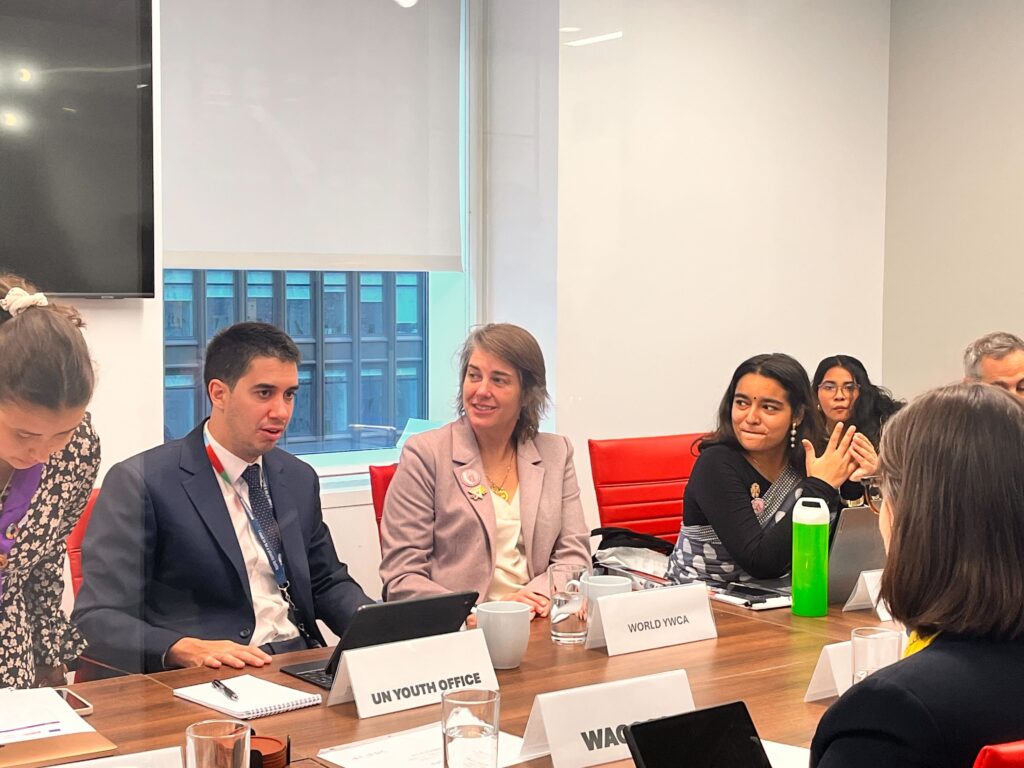
On the sidelines of the 79th United Nations General Assembly (UNGA) and the Summit of the Future, World YWCA and its partners in the Big Six Youth Organizations held a high-level roundtable under the Global Youth Mobilization initiative. Our call was clear: policymakers and global leaders must “walk the talk” by supporting youth engagement through intergenerational action.
The event brought youth activists together with civil society leaders and policymakers, including the Big Six leaders, EU Commissioner Jutta Urpilainen, and UN Assistant Secretary-General for Youth Affairs Dr Felipe Pauiller. This provided a critical opportunity to highlight the impact of the Global Youth Mobilization (GYM) model. Since its inception, GYM has provided young people with direct financial support, training, mentorship, and networking opportunities, enabling them to lead initiatives that address pressing social issues within their communities.
In her passionate closing remarks, YWCA India youth leader Yashika Sharma shared how the GYM has enabled her to embark on an innovative project. Led and designed by young women, the project will use the World YWCA’s signature tool, RiseUp! Leadership training programme and the Feminist Consultation Methodology to create a “by community” initiative. Yashika proudly explained how this will “truly walk the talk in local contexts”.
Reflecting on the significance of intergenerational collaboration, Casey Harden, General Secretary and CEO of World YWCA, emphasised that genuine progress requires contributions from all generations.
“At World YWCA, we believe that true leadership thrives when diverse perspectives and experiences, across age groups, are recognised and valued. Intergenerational leadership is not just about involving young people for appearances, but about fostering a partnership where they are equal participants in decision-making and action,” she said. “It’s through this mutual respect and collaboration that we can address the complex challenges of today’s world effectively.” – Casey Harden General Secretary and CEO of World YWCA
Building on this commitment, World YWCA will be launching an intergenerational leadership guide later this year, designed to offer practical insights on how to foster collaboration across age groups.
Intergenerational leadership is critical to challenging trust with different ages. This is why, throughout this session, Casey Harden asked attendees to consider when and why they focus on risks when talking about youth initiatives. She invited them to think about the risks we are constantly taking across the sector, and question why they tend more towards caution when it comes to youth investment.
Leaving this impactful conversation, we invite organisations to join us in challenging the dominant narrative and practices around intergenerational leadership to foster collaboration across age groups. Let us focus on leading with trust.
“What do we ask from you? Open up spaces, resources, and policies in ways that underline the feminist values of collective-building, trust and accountability towards everyone, including Young People. Intergenerational Action is key to ensuring we are not just seeing young people as “tools” or “beneficiaries” but as “co-creators” of the today.” – Yashika Sharma, #YWCALeader India RiseUp! Lead
We need this kind of intergenerational action to make the Sustainable Development Goals (SDGs) and YWCA’s Goal 2035 a reality. We need everyone working together to ensure youth leaders have spaces, tools, resources and funds. We must work together as the co-creators of today, for tomorrow.
This event and its collaborative discussion was a step in this direction.
Global Youth Mobilization was born as a response to COVID-19 and has grown into a movement. Its success is a testament to the power and resilience of youth when they have access to funding, resources, and training. With the support of the EU Youth Empowerment Fund and in partnership with the EU Commission, we are scaling this initiative to reach even more communities.
As the World YWCA, we remain committed to supporting youth as co-creators of today’s solutions. Through initiatives like GYM, we provide critical resources and foster leadership deeply rooted in feminist values and intergenerational collaboration.
On Tuesday, 8 October 2024, World YWCA will continue these powerful conversations with the European Commission in Brussels, at the Global Gateway High-Level Youth Event. To learn more about the Global Youth Mobilization and how it continues to make a difference, visitglobalyouthmobilization.org.
The YWCA Haiti calls for the solidarity of the YWCA global movement, partner organisations, and worldwide support for lasting peace and humanitarian support.
World YWCA movement and leaders have a long and constant history of responding to conflict and post-conflict situations, and demanding the protection of the human rights of internally displaced people, especially girls, young women and women, as they are usually most adversely affected.
Haiti, a Caribbean state sharing an island with the Dominican Republic, is currently grappling with an unprecedented and quickly escalating security crisis. Following the assassination of President Jovenel Moïse in July 2021, the country has been left with a power vacuum plunging the nation into chaos marked by escalating political instability and corruption, collapse of infrastructure, economic paralysis, and soaring gang violence and gender-based violence. Today, criminal groups control approximately 80% of Port-au-Prince, the national capital, and continue to expand their grip over the country. These gangs operate with impunity, undermining the rule of law, dominating neighbourhoods, and deepening the suffering of the Haitian people. Alarmingly, previously rival factions have now formed alliances, further complicating efforts by Haiti’s overstretched and under resourced National Police (PNH) to contain the violence.
The scale of displacement resulting from gang violence is staggering. As of now, there are 702,973 internally displaced persons (IDPs) in Haiti, a figure that grows daily. Among them, 54% are women and 52% are children, reflecting the disproportionate impact on the most vulnerable populations. Over 1,042 displacement sites have been established, with more than 20,000 individuals displaced in just four days across Port-au-Prince. Many of these people have faced repeated displacements, forced to flee violence multiple times and leaving behind what little they had managed to rebuild. The current scale of displacement is the worst Haiti has seen since August 2023.
The YWCA Haiti, located in Pétion-Ville, a city of Port-au-Prince, has been working for the past 15 years to support young women and girls in marginalised at-risk communities, providing a safe space and life skills training aimed at promoting their leadership, providing educational support, and providing access to essential health care services through partnerships with local organisations. Through our work at the grassroots level, we realise that women and girls too often face increased risks of sexual violence, abduction, and exploitation as gangs use these acts as weapons of war to instil fear and control communities. Children not only have to suffer the trauma of violence in their neighbourhoods but also interrupted education, malnutrition, exposure to cholera, and severe mental health distress.
This week, this crisis has disrupted critical supply chains, isolating Port-au-Prince and leaving the metropolitan area in near-total paralysis. The closure of air traffic following targeted shootings last week at three commercial aircraft over the city, restricted access to the main seaport, and unsafe roads controlled by armed groups have compounded the suffering of already vulnerable populations. Gang-related violence has caused nearly 4,000 deaths in 2024 alone, and gender-based violence, including sexual violence as a weapon of terror, has reached alarming levels. Women and children, who make up 94% of those at heightened risk of violence, endure the worst of this relentless brutality.
The recent attack on Solino, displacing over 17,000 people to 15 emergency sites, and the massacre in Pont-Sondé are grim examples of the terror inflicted on communities. These events underscore the human cost of unchecked gang violence. The international community cannot afford to stand by as Haiti descends further into turmoil. Urgent humanitarian assistance is needed to support displaced populations, address the immediate risks of sexual and gender-based violence, and restore access to critical infrastructure. At the same time, a coordinated and sustainable effort is essential to strengthen the rule of law, protect human rights, and empower Haitian communities to rebuild their country.
Born of a collective commitment made at the World Council of the YWCA in 2007, we call on all international bodies to be accountable and implement United National Security Council Resolution 1325 on Women, Peace and Security (2000). We also want to ensure the leadership role and meaningful engagement of Haitian women in resolving the internal conflict and in peace-building efforts.
Women, young women, and children must be at the heart of these efforts, as they hold the key to creating a peaceful, equitable, and resilient Haiti that can secure a better and safer future for all, especially the young generations.
To learn more about how to support YWCA Haiti, contact Sandrine Kénol Wiener, Executive Director of YWCA Haïti at skenol@ywcahaiti.com or info@ywcahaiti.com.
Listen to powerful stories and first-hand accounts of YWCA leaders from countries facing conflict and violence through our #BulletAndDove peace and justice campaign.
References:
17 November 2024. Over 20,000 Flee as Rising Gang Violence Spurs Mass Displacement in Haiti. By OIM UN Migration
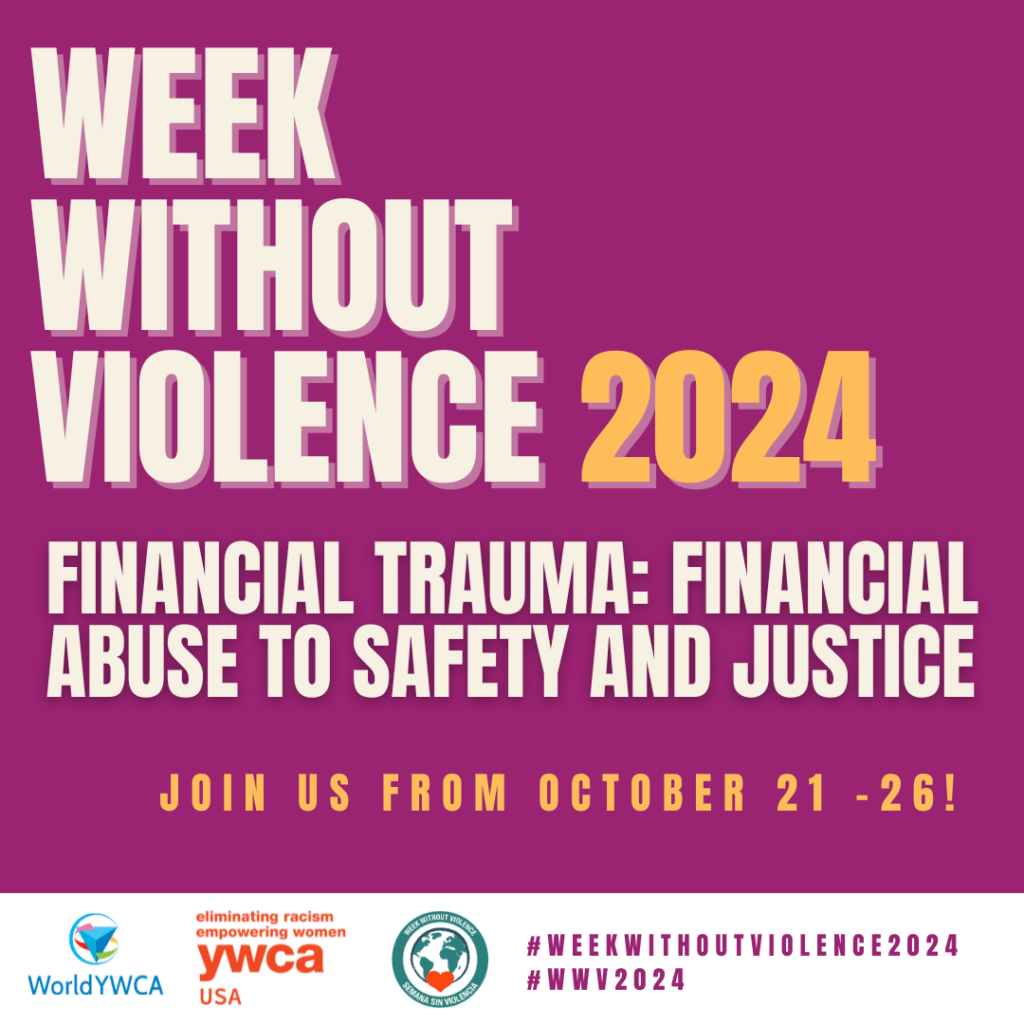
YWCA’s Week Without Violence is an annual global campaign held during the third week of October every year. For over 25 years, this campaign has been dedicated to raising awareness, promoting change, and enabling positive action to end violence against women, young women, and girls in all their diversity.
For this Week Without Violence 2024, World YWCA is partnering with YWCA USA to spotlight financial abuse as a form of violence. Each day of the week, we will focus on different aspects of financial abuse, bringing attention to its various forms and impacts
Join us from October 21-26,2024, under the theme ‘Financial Trauma: From Abuse to Safety and Justice for Women,’ This year tool is designed to support deeper understanding for women and young women globally. It highlights financial abuse and provides actionable solutions to inform, protect and guide you toward achieving financial safety, independence and justice. This tool helps advocate for financial equity and raises awareness about how financial challenges disproportionately affect women’s rights and gender equality worldwide. With a global, intergenerational focus, the tool breaks down key elements of financial trauma to generate awareness and critical thinking through a solution-oriented approach.
The tool includes research studies and resources from around the world, acknowledging that many more resources exist that haven’t been added. These are just some suggested framings, which we urge being explored from your unique perspectives in your country and community. As you deep dive, consider reflecting on the following question: “How might these experiences relate to financial dynamics in your country or community?”
Join us in the fight for a safer, more inclusive world in 2024. Don’t forget to engage on social media using the hashtags #YWCALeaders #WeekWithoutViolence2024 #WWV24
The World YWCA calls on YWCA leaders and all global citizens, especially those not living in crisis in the Middle East, including allies of countries directly involved, to exert immediate pressure on Israel and all other parties involved to stop this war that has already produced thousands of deaths and tens of thousands of injuries, especially in Palestine and Lebanon. We especially urge those in formal power and member states of the United Nations to immediately cease hostilities and prevent further injury, death, displacement, and trauma to the peoples of the Middle East. Moreover, immediate humanitarian aid must be mobilised to meet the urgent needs of those affected.
Since 1948, the Israeli Occupation and successive aggressions on the Palestinian territories and neighboring countries have directly impacted millions of women and children in the Middle East region, leaving them homeless, displaced, with no protection, and, most recently, with no safe space to go to. We affirm the need for the Israeli Occupation to end, for there can be no peace and justice with the Occupation.
Yet again, the disease of war rears its head – continued attacks by Israel on Lebanon and Palestine and the spread to Yemen, Iraq, and Syria. This is then followed by a cycle of counter-response, in a cycle of violence.
The World YWCA movement stands in unwavering solidarity with the people of the Middle East, especially children and women of the Middle East, who have been and continue to be disproportionately and negatively impacted by this escalation. Already, they endure the harsh realities of occupation, consistent violence and aggression, violation of their basic rights, systemic exclusion and marginalization, mobility restrictions, and all forms of injustice, including economic and political injustice. This is not tolerable.
We call upon every global citizen to take action: to speak, to write, to post on social media – advocate for an end to the violence in the Middle East. Individual actions turn into collective action, which is how we change unjust power structures.
The YWCA’s longstanding solidarity for peace and justice in the region began formally in 1967 at a meeting of YWCA leaders from around the world in Melbourne, Australia, and has culminated in twelve formal statements of support and calls to action.
Follow #bulletanddove and listen to the voices of women on the ground through these podcasts and listening sessions. Join the YWCA movement in transforming power structures towards lasting peace and justice.
Thursday, October 3rd, 2024
The YWCA Lebanon calls for the solidarity of the YWCA global movement, partner organisations, and worldwide support for lasting and equitable peace.
Mona Khauli, National Executive Director of YWCA Lebanon, shares:
“At a time when Lebanon is facing an unprecedented economic collapse, Israel’s massive offensive launched on Monday has resulted in the tragic loss of 700 lives, and the death toll continues to rise as Israel dismisses global calls for a ceasefire. Over 1,835 people have been injured. Ten of thousands of families have been forced to flee their homes in the Bekaa, South Lebanon regions and Beirut suburbs, and essential services are becoming increasingly scarce. More than 500,000 individuals are now displaced, including around 140,000 children from southern Lebanon who have been forced from their homes in the past four days. Schools have been hastily converted into shelters to accommodate the displaced population. The tragic reality is that Lebanese are already financially destitute owing to high inflation, lack of resources, and diminishing income, and they now have to find safe housing and pay extra to relocate which is sheer madness; nothing less than another “Gaza” genocide, with no restrictive measures whatsoever. Moreover, Israel is now promising another massive strike on Beirut.
The YWCA of Lebanon appeals to the international community to exert immediate pressure on all parties involved to cease hostilities and provide urgent humanitarian aid to address the dire needs of the Lebanese population. We strongly support initiatives aimed at achieving a lasting and equitable peace.”
The World YWCA and the global movement of millions of people work for peace with justice to prevent conflict, provide safe spaces, and work with governments and other actors to end structural violence and support survivors of violence – including meaningful participation of women and young women in leading peace processes.
At the 30th World YWCA Council in November 2023, the highest decision-making body of the global YWCA movement, adopted a resolution to promote human rights and supporting the Middle East region’s movements work towards sustainability.
The World YWCA supports YWCA Lebanon as they share witness of that impact and their appeal to the international community to exert immediate pressure on all parties involved to cease hostilities and provide urgent humanitarian aid to address the dire needs of the Lebanese people.
YWCA women have worked in conflict and post-conflict for more than a century to advocate for peace and justice in communities, countries, regions, and the world. We believe sustainable peace is only possible when women are fully involved in resolving conflict, and peace and security efforts.
The first cycle of the Open Call offers micro-grants to support innovative, youth-led projects addressing local challenges. Targeting vulnerable youth, including those from socio-economically disadvantaged backgrounds and those facing gender equality issues or disabilities, the initiative provides funding to enable impactful solutions. Young Individuals and Informal groups can receive between 500-1500 EUR, while registered organisations may obtain 3000-5000 EUR.
The launch is part of a broader effort by the European Union and the Big Six Youth Organisations to support the achievement of the Sustainable Development Goals (SDGs) and to empower young people to play a more active role in their communities. It is part of the €10 million EU Youth Empowerment Fund through the Global Youth Mobilization Initiative, announced in Kenya on the first anniversary of the Youth Action Plan for EU External Action in 2023. The Fund provides resources for young people globally to advance the objectives of Agenda 2030 in line with the EU’s Global Gateway strategy.
European Commissioner for International Partnerships Jutta Urpilainen said: “The EU Youth Empowerment Fund is there to help young people get their ideas off the ground and contribute to sustainable development in their community. These concrete opportunities that we are delivering to young change-makers around the world in partnership with the Big Six and the Global Youth Mobilization are exactly what our first-ever EU Youth Action Plan is about: engage, empower, connect.”
YOUTH TAKES THE LEAD
The Open Call invites young individuals and youth groups to develop and implement innovative project ideas that address challenges within their local communities. Projects must contribute significantly to the achievement of the Sustainable Development Goals (SDGs) through youth creativity and leadership in vulnerable settings.
What really excites me about this initiative is its commitment to putting young people in the driving seat at every level – from governance, to making decisions about funding, to project implementation and advocacy. (…) Over the next three years, together we will see that young people can, and will, make a huge impact on the SDGs to create a more positive future for us all.
Helga Mutasingwa, WAGGGS World Board Memberand Former GYM Youth Board Representative
As part of the partnership’s joint pledge and strategy, the Open Call will provide mentoring and coaching opportunities, along with capacity-building to enhance the resilience and empowerment of young people.
Youth are actively involved through the Global Youth Mobilization at all levels, taking charge of selecting grant recipients, serving on the initiative’s Board, and participating in the design and implementation of community projects.
The selection process will be ‘by youth, for youth’ involving Youth Panellists from a wide diversity of backgrounds selected from around the world. During the selection process, applications will be reviewed, scored, and discussed in youth panel meetings. Successful applications will be awarded funding, either unconditionally or with conditions requiring additional information or recommendations. Unsuccessful applicants will also receive feedback to improve their ideas or strengthen future submissions.
– Young individuals – Informal groups – Registered youth-led organisations
Focus areas:
Projects addressing global challenges aligned with the Sustainable Development Goals (SDGs)
Encouraged applicants:
– Individuals from diverse backgrounds
– Underrepresented groups, including young people in challenging circumstances, those from lower socio-economic backgrounds, and individuals facing barriers related to gender or disability
For more information about the Open Call, please visit the GYM website.
BACKGROUND
The EU Youth Empowerment Fund through the Global Youth Mobilization is a partnership between the European Union and the Big Six Youth Organisations.
The European Union’s initiatives for and with youth globally are directed by the Youth Action Plan (YAP) in EU External Action for 2022-2027. This plan, the first of its kind, establishes a strategic partnership framework with young people worldwide. It highlights the importance of youth as catalysts for change and essential partners in realising the 2030 Agenda for Sustainable Development and other international commitments such as the Paris Agreement on climate change. The YAP aims to ensure that EU External Action contributes to youth empowerment politically, socially, and economically while facilitating their meaningful involvement in decision-making and policy formulation around the globe. The EU Youth Empowerment Fund is one of the key actions that support young people
The Global Youth Mobilization (GYM) was launched by the Big Six youth organisations in 2020. From 2020 to 2022, GYM invested over US$ 5 million in 640 youth-led projects, engaging more than 600,000 young people and impacting over 3.6 million people in more than 125 countries. Through the funding of the European Union’s Youth Empowerment Fund, the Global Youth Mobilization will continue to support young people globally.
The Big Six Youth Organizations, formed in 1996, is an alliance of leading international youth-serving organisations. The alliance includes the World Organization of the Scout Movement (WOSM), the World Alliance of Young Men’s Christian Associations (World YMCA), the World Alliance of Young Women’s Christian Associations (World YWCA), the World Association of Girl Guides and Girl Scouts (WAGGGS), the International Federation of Red Cross and Red Crescent Societies (IFRC), and The Duke of Edinburgh’s International Award (The Award).
Collectively, the Big Six engage over 250 million young people, contributing to the empowerment of more than one billion young individuals over the last century.